
How smarter content design can help reduce the energy consumption of your LED display
When improving the energy efficiency of an LED display, the hardware is often the first place people look. More efficient LEDs, advanced chip technologies and lower power electronics all play an important role in reducing electricity use.
However, one of the biggest opportunities to improve efficiency often lies somewhere much simpler: the content displayed on screen.
"The way you design content can make a difference to the amount of power an LED display consumes," explains Jack Wilders, Solutions and Complex Projects Team Manager at Sharp Displays. "By making a few conscious design decisions, it's possible to reduce energy usage without compromising visual impact."
For anyone operating large digital signage networks, even small improvements in efficiency can contribute to lower operating costs over the lifetime of the installation. Designing content with energy efficiency in mind also supports organisational objectives to reduce electricity consumption and related operational emissions, making it a win for both budgets and the environment.
Jack Wilders, Solutions and Complex Projects Team Manager

Content for conscious consumption
The content displayed on screen influences the power consumption of all display technologies, but the effect is most significant with direct view LED (dvLED), where every pixel generates its own light. Bright, high-intensity images require more energy, while darker, more balanced content uses considerably less. A full white screen demands far more from the display than a design that uses darker tones and carefully controlled highlights.
One way of measuring this is Average Picture Level (APL), which describes the overall brightness of the content shown on screen. The lower the APL, the less power the display typically consumes.
"Many people focus on display brightness, but the content itself often has a much greater influence on day-to-day energy consumption," says Jack. "The goal isn't to make content darker; it's to make it smarter."
Jack recommends five simple ways to create more energy-efficient content without sacrificing creativity or impact.
1. Avoid full white backgrounds
One of the simplest ways to lower energy consumption is to avoid large areas of pure white. White requires the red, green and blue LEDs within every pixel to operate at maximum output simultaneously, making it the most energy-intensive colour to display.
Instead, consider using mid-tone backgrounds such as deep greys, muted blues or rich reds. These colours not only require less power but often create a more sophisticated, premium look while allowing brighter elements to stand out more effectively.
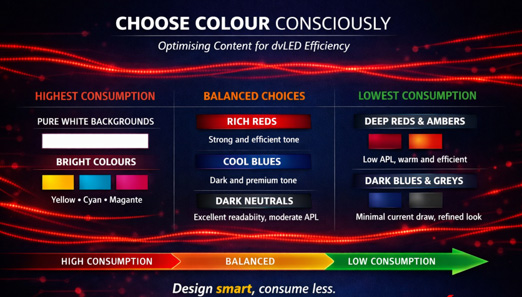
2. Choose colours consciously
Not all colours consume the same amount of energy. Thoughtful colour selection can improve both efficiency and visual appeal.
| Higher energy use* | Well-balanced choices | Most energy efficient* |
| Pure white | Rich reds | Deep reds |
| Yellow | Cool blues | Amber tones |
| Cyan | Dark neutral tones | Dark blues |
| Magenta | Greys |
*Typical results may vary depending on display technology and configuration
Many organisations are surprised to discover that small adjustments to their colour palette can reduce energy consumption while improving readability and creating a more refined visual style.
3. Design for balance, not brightness
Brighter content isn't always better. In many indoor environments, excessive brightness can actually reduce readability and create visual fatigue, while increasing energy use unnecessarily.
Instead, Jack recommends operating displays at around 60–70% of their maximum brightness, which can reduce power consumption by up to 40% depending on display model, content and operating conditions, while still delivering vibrant, engaging images.
Aim for an Average Picture Level of around 40–60%, providing enough luminance for clear communication without relying on large bright areas.
4. Use contrast intelligently
Strong contrast is essential for readability, but that doesn't mean every design needs stark black and white extremes.
Combining darker backgrounds with mid-tone colours and using white selectively to highlight key messages creates content that is both visually engaging and more energy efficient.
Good design isn't simply about making everything brighter. It's about directing attention where it matters most.
5. Keep motion purposeful
Animation is an effective way to attract attention, but more movement doesn't necessarily deliver better results.
Rapid transitions, flashing graphics and constant full-screen animation require the display to work harder, increasing energy use while often making content feel cluttered or distracting.
Smoother transitions and subtle animation not only consume less power but often create a more polished, professional viewing experience. In many environments, restrained movement is more effective at capturing attention than constant visual noise.
Typical results may vary depending on display technology and configuration
Small design decisions can make a big difference
The most effective content doesn't rely on maximum brightness to capture attention. Thoughtful use of colour, contrast and motion creates displays that are easier to read, more engaging for audiences and more efficient to operate.
For organisations managing large display networks, those improvements can add up over time electricity consumption and, where electricity-related emissions are measured, contributing to sustainability objectives.
As Jack concludes:
"The most efficient content isn't the darkest content. It's content that's designed with balance in mind. Small creative decisions can deliver significant energy savings over the lifetime of an LED display."
Maximising efficiency across your display network
While content design can make a measurable difference, it delivers the greatest benefit when combined with intelligent display management. Together, these technologies help organisations reduce power consumption across their entire display estate.
Sharp's Remote Power Switches eliminate unnecessary standby power by switching LED displays off when they're not required. Remote management tools such as Sharp's NaviSet Administrator enable brightness levels, operating schedules and power settings to be managed centrally, while automated scheduling and ambient light sensors ensure displays only use the energy they need.
These principles can improve the efficiency of any LED installation. Pairing them with energy-efficient display technology delivers even greater savings. In internal testing, Sharp's LD-EC Series, featuring Flip Chip CoB technology, consumed up to 60% less power than conventional SMD LED solutions under comparable test conditions, without compromising exceptional image quality.
Watch the video to learn how the Sharp LD-EC Series combines outstanding visual performance with industry-leading energy efficiency.
Energy savings and power-consumption reductions depend on display model, brightness settings, content characteristics, operating schedules and environmental conditions. Any percentage savings quoted are based on specific test conditions and actual results may vary.