
8 critical questions to ask your Display Solutions Partner in 2026
As the AV landscape evolves, it’s important to rethink what truly matters when specifying professional displays. Procurement decisions should not rely simply on technical specifications such as brightness, or unit price.

Rapid advances in LED technology, stricter sustainability requirements, heightened cybersecurity risks, and the shifting demands of hybrid work are all adding new layers of complexity. To secure long-term performance, reliability and value, organisations need a display partner, not just a supplier, who can help navigate these challenges and guide safe, sustainable investment choices.
Before you commit to your next AV project in 2026, here are eight critical questions to ask your display solutions partner.
LEARN MORE about why now is the perfect moment to build meaningful partnerships.
1. Will the product deliver long life performance?
Long-term reliability begins with high-quality engineering. Commercial-grade displays are purpose-built for sustained use often in demanding conditions, and that’s what separates a screen that simply looks good today from one that will continue performing at its best for many years to come.
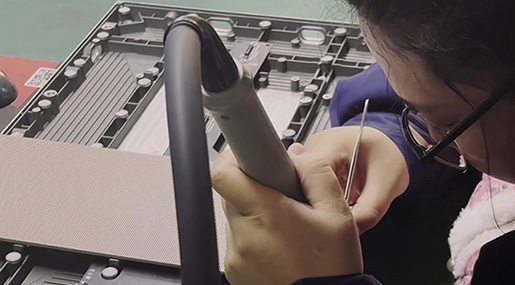
Every Sharp LED module goes through a manual quality control inspection
Ask your display partner about the published operating hours (eg 16/7 vs 24/7) and the environmental conditions under which the display is designed to operate. They should also be able to explain their factory testing procedures and provide transparency around failure rates.
Component selection and design are key to achieving long-term reliability. A metal chassis provides rigidity and efficient heat dissipation, protecting internal components from thermal stress and extending product lifespan. With carefully selected components and rigorous quality control, Sharp ensures consistent, reliable performance from day one.
LEARN MORE about why product quality and testing matter in dvLED displays.
2. What’s the total cost of ownership (TCO), not just the purchase price?
A lower upfront cost can hide higher lifetime expenses. Is important to consider the ongoing operational costs associated with the display such as power consumption, maintenance and potential downtime.
A longer product lifecycle will reduce the total cost of ownership. While a low-cost display might seem appealing initially, if it requires frequent repairs or early replacement, its true cost can quickly exceed that of a high-quality professional display designed for reliable, long-term performance.
Don’t just rely on the published power consumption figure, ask about the usage scenarios behind this data to ensure it reflects your actual operating conditions. Find out what tools are available to help reduce energy use, such as ECO sensors, scheduling features and remote power switching. Request a full TCO projection. Tools such as Sharp’s TCO Calculator help organisations to compare long-term value rather than focusing only on the initial purchase price.
LEARN MORE 5 easy ways to reduce your business energy bills.
3. Is the product safe for use in public environments?
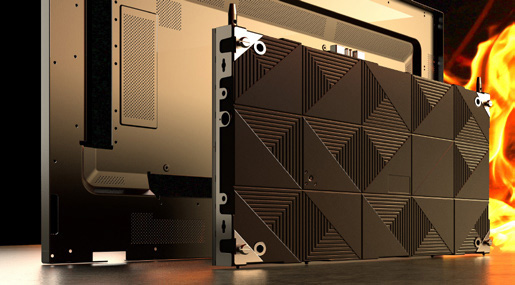
Any surface materials used on or inside buildings must comply with fire safety standards, and display installations will fall under this category. Fire load testing evaluates how materials react to fire, including their contribution to fire spread and whether they produce smoke or burning droplets, to ensure safety compliance.
Ask your display partner to provide a statement of compliance detailing its product’s reaction to fire performance.
As a non-combustible material, metal offers high heat resistance and an exceptionally high melting point. With metal forming the largest part of the construction, Sharp’s products are tested to the EN13501-1 fire classification and are proven to meet stringent fire safety standards.
WHITEPAPER Why fire safety is of critical concern, and how Sharp products are trusted for their proven fire safety compliance.
4. What upgrade or modular options do your products offer?
Technology evolves quickly but early replacement is neither economical nor sustainable. Modular designs allow devices to be upgraded or reconfigured to meet future usage requirements, extending their life and reducing e-waste.
Ask about interchangeable hardware and reusable components which can help lower costs and support more sustainable operation.
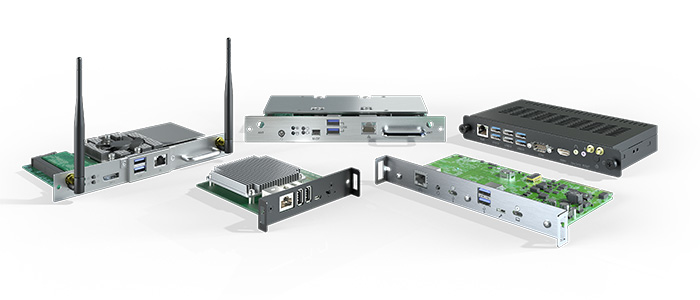
Sharp’s M and P Series of large format displays feature an option slot that allows computing modules to be upgraded without having to replace the entire display. Our LED solutions are highly serviceable enabling modules to be upgraded without changing the infrastructure. New projector models are compatible with legacy mounts and lenses allowing users to reuse existing components.
LEARN MORE about Sharp’s modular computing solutions.
5. What’s the plan for software, firmware, and connectivity updates?
Displays are now intelligent networked devices. Out-of-date firmware or security patches can cause vulnerabilities or compatibility issues. A trusted partner will commit to long-term update support and remote management tools, ensuring displays evolve with your ecosystem.
If cybersecurity is a concern, ask what safeguards are in place to protect your devices and network from malicious attacks.
Sharp offers enterprise-grade device and network protection including lockable settings, IEEE 802.1X authentication and proactive system management to keep your AV/IT environment safe and efficient. Over-the-air (OTA) firmware updates and continuous Android security patches ensure resilience against emerging threats.
6. How well does the solution integrate with existing platforms and peripherals?
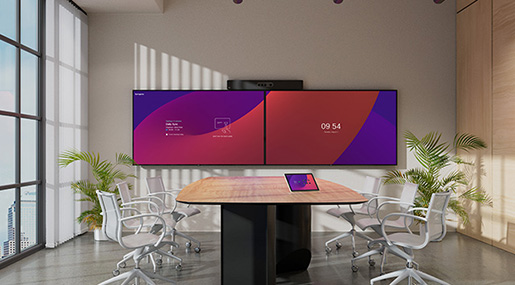
Strong interoperability makes deployment easier, reduces training needs, and allows equipment to fit naturally into your existing technology environment, minimising friction for users and avoiding costly infrastructure changes.
When a display works seamlessly with meeting room systems such as Cisco Webex, Zoom, Crestron RoomView, and Barco ClickShare, and is natively compatible with HDMI, USB-C, and other room peripherals, users can walk into any space and start presenting or collaborating immediately. This unified experience also helps support teams diagnose and resolve issues more efficiently.
Ask your display partner about interoperability and proven compatibility with your preferred platforms.
LEARN MORE about Sharp’s compatibility with Cisco collaboration devices.
7. How is the display serviced and supported after installation?
Regular maintenance can significantly extend the life of devices while improving performance and minimising downtime. Preventative servicing also allows early detection and resolution of problems such as overheating, outdated firmware, and displays that are not optimally configured.
Remote management tools such as Sharp’s NaViSet Administrator are particularly useful for large estates, helping to highlight when proactive maintenance is needed to keep a network of devices running smoothly.
Having a clear service plan is essential, especially for LED investments, to ensure you benefit from their exceptionally long lifecycle. Make sure you understand service levels, turnaround times, and spare-part availability.
Sharp’s Service Plus program offers a wide range of customisable, region-based support options for complete peace of mind.
LEARN MORE about why an LED Service Program is essential to maximise its 10+ year potential.
8. What are the environmental and energy-efficiency credentials?
Eco-labels and sustainability claims should be backed by verifiable standards such as TCO Certified, Energy Star, or EPEAT, where applicable.

If you are using power consumption figures to compare products, ask about the real-life usage scenario behind the data, otherwise, comparisons can be misleading if you’re not comparing like-for-like.
Ask how the manufacturer measures embodied carbon, material sourcing, and recyclability. Sustainability is a complex topic so be cautious if your supplier provides data without backing it up with comprehensive evidence.
Remember, sustainability starts with quality. Choosing products built to perform reliably over the long term reduces waste, conserves resources, and delivers lasting value, making durability the smartest, most sustainable choice.
LEARN MORE about how data can be misleading and how Sharp’s commitment to transparency helps customers make informed, meaningful decisions.
Choose a trusted parter that can help you plan for the next 5–10 years
When the conversation shifts from “how bright is it?” to “how long will it perform, and how efficient will it be?”, you move from transactional buying to strategic investment.
Your display partner should act as a consultant, advising on best-fit technology solutions, lifecycle planning and emerging technology roadmaps. Choose a partner who listens, anticipates change, and aligns with your business objectives.
In 2026 and beyond, organisations need to invest in AV equipment that’s flexible, secure, and sustainable. We’re here to support you and help you plan for the future with confidence.