

Beyond the Specification: Three Priorities for Workplace Technology in Legal and Professional Services
Following the Legal & Professional Services Workplace Technology Forum, hosted by Sharp and Q-SYS at Travers Smith in London, Kate Butcher, End User Account Manager for the legal and professional services sector at Sharp UK Display Solutions, reflects on the key themes emerging from the discussion and what they mean for workplace technology decisions.
The roundtable event brought together nineteen AV and IT professionals from ten leading legal firms to explore three important questions:
- How do legal firms define quality and reliability in AV?
- Where could greater simplicity make the biggest difference to workplace technology projects?
- How is sustainability influencing the way technology is specified and procured?
The discussions highlighted the importance of looking beyond individual products and specifications to consider wider business needs, operational demands and the long-term value of workplace technology.
Kate Butcher, End User Account Manager - Legal and Professional Services, Sharp UK Display Solutions

This broader perspective is particularly relevant as law firms look for new ways to improve profitability. With traditional rate increases becoming a less dependable driver of profit growth, attention is turning towards operational efficiency, productivity and making better use of existing resources. That includes reviewing how office space is used, streamlining day-to-day operations and ensuring technology investments deliver measurable value.
This shift reflects wider trends across the legal sector. In its October 2026 analysis, Morphis explores why operational efficiency, productivity and cost discipline are becoming increasingly important drivers of profit growth, drawing on findings from PwC's 2026 Law Firm Survey.
1. Quality and reliability go beyond the specification
For legal firms, workplace technology supports a range of business-critical activities, from welcome signage and wayfinding to meetings, hybrid collaboration, client presentations, training and larger events. When displays fail, meeting rooms won't connect or presentations are disrupted, the impact can extend beyond inconvenience to affect client confidence and the firm's reputation. Reliable technology is therefore a business priority, not simply a technical consideration.
During the roundtable, participants highlighted the importance of understanding use cases, collaborating with stakeholders, ensuring consistent support and balancing cost against value. Product longevity, warranties and end-of-life planning were also raised as important considerations when assessing risk.

The initial purchase price is only one element of the investment. Energy consumption, maintenance, service support, downtime and early replacement all contribute to the total cost of ownership, as does the potential impact of technology failure on productivity and the client experience.
Display Solutions for the long haul: how to maximise the value of your investment
Find out why total cost of ownership (TCO) and return on investment (ROI) should guide every purchasing decision, not just the initial price tag.
2. Make simplicity a priority

As workplace technology evolves, managing multiple devices, platforms and systems across an estate can become increasingly complex. This affects both the teams responsible for supporting the technology and the people expected to use it.
At the forum, participants identified opportunities to simplify AV projects through better provisioning, deployment templates, straightforward installation and more intuitive operation. Interoperability and consistency across spaces were also important considerations. Standardisation can make deployment and ongoing support more manageable, reduce the burden on IT teams and help control operating costs.
Involving stakeholders early helps ensure solutions reflect how spaces will actually be used, which systems need to work together and who will manage them. Familiar room experiences and straightforward controls should make technology easier to use, support and manage, helping firms get more from their existing resources.
Enabling Consistency at Scale: The Global Customer Program
Giving multinational enterprises a simple, standardised way to manage their visual technology around the world with consistent products, support, and service, all through one point of contact.
3. Consider sustainability throughout the lifecycle
Sustainability was the third key theme, with participants discussing product recyclability, energy consumption, packaging, carbon footprint and the importance of assessing the full product lifecycle.
The environmental impact of workplace technology extends beyond procurement. It includes the resources required to manufacture and transport equipment, the energy it consumes during operation, how long it remains in use and what happens at the end of its working life. Keeping suitable equipment in service for longer, through repairability and modular design, can reduce the need for replacement and the associated use of materials and resources.
Energy consumption also requires careful consideration. Understanding how displays will be used and their actual power consumption can help firms make informed comparisons. Transparency is essential, with customers needing credible evidence to assess sustainability claims and understand the environmental implications of their choices.
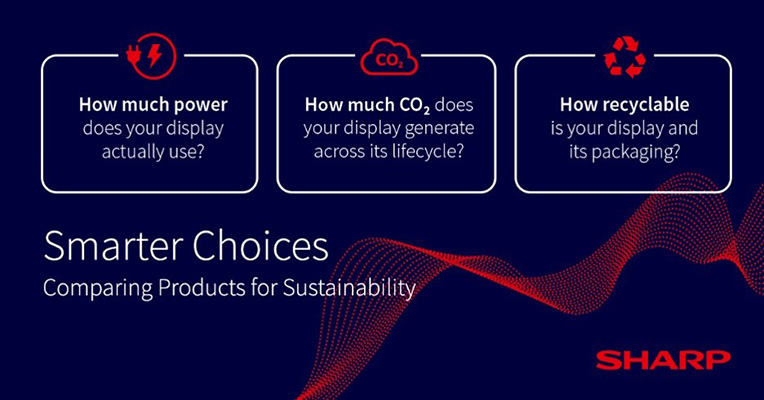
Smarter Choices: Comparing products for sustainability
When completing a tender, don’t just take figures at face value. Ask for the detail, verify the data, and make smarter, more sustainable choices. Ask your supplier these three questions.
Putting the principles into practice: Travers Smith
The forum took place at Travers Smith's new headquarters at Stonecutter Court, providing a real-world example of workplace technology designed around a range of professional environments and applications.
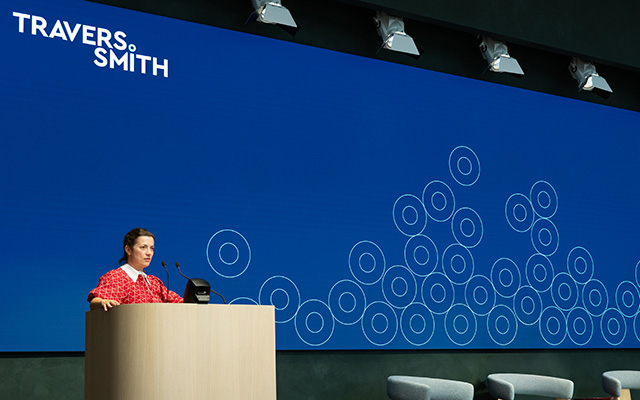
Following its move from two London offices, Travers Smith created a new headquarters to support collaboration, client engagement, hybrid working and firm-wide communications. The project, delivered by Sharp's global partner Kinly alongside Overbury, included more than 60 technology-enabled spaces across nine floors.
These include meeting rooms, boardrooms, training suites, informal collaboration areas, a recording studio and a flagship auditorium.
The breadth of spaces reflects the need to make workplaces work harder, supporting different activities and ways of working within a single office environment. Technology plays an important role in enabling this flexibility and helping firms maximise the value of their workplace investment.
At the centre of the auditorium is a 1.2mm pixel-pitch 8K LED installation measuring approximately 9.6 metres wide by 2.7 metres high. Sharp also supplied fine-pitch LED and MultiSync® display solutions for meeting rooms, collaboration areas, digital signage and workplace communications.
Explore the Travers Smith case study to learn more about the project and the technology delivered across the firm's new headquarters.
Travers Smith: Creating a technology-enabled headquarters for collaboration and connection
Five questions to ask before your next workplace technology investment
The roundtable discussion highlighted the importance of taking a considered approach to specification and procurement. Before committing to a new project, decision makers should ask:
1. Have we defined the use cases? Understand the needs of the people using each space and involve the relevant stakeholders before selecting technology.
2. Can we support it over time? Consider expected lifespan, maintenance, warranty, service provision and end-of-life options.
3. Will it be simple to use and manage? Assess deployment, interoperability, consistency and the day-to-day experience for both users and support teams.
4. Are we evaluating total value? Look beyond purchase price to energy consumption, maintenance, downtime and potential replacement costs.
5. Can we assess its environmental impact? Examine product longevity, energy use, repairability, recyclability and the evidence supporting sustainability claims.
Together, these questions provide a practical starting point for making informed decisions and keeping workplace technology investments aligned with business needs.
Better decisions start with the right questions
The Legal & Professional Services Workplace Technology Forum reinforced the importance of looking beyond individual products and specifications to consider the wider needs of the business.
As firms look for ways to improve efficiency, manage costs and make better use of existing resources, workplace technology has an important role to play. Reliability, simplicity and sustainability are interconnected considerations, helping firms protect their investments, reduce operational complexity and make informed decisions for the long term.
At Sharp, we work with customers and technology partners to help select display solutions suited to the requirements of each environment, from meeting and collaboration spaces to large-scale auditoriums. The objective is simple: to deliver the right technology for the space, the people using it and the business it needs to support.
For firms reviewing their workplace technology or considering future projects, Kate Butcher, Sharp’s End User Account Manager for the legal and professional services sector, welcomes the opportunity to discuss their requirements and explore potential solutions.
Kate.Butcher@sharp.eu linkedin.com/in/kate-butcher-75076a93/
The Legal & Professional Services Workplace Technology Forum was jointly hosted by Sharp and Q-SYS at Travers Smith’s new headquarters in London on 1 October 2026.